AI game master: what the Narrator does and what it doesn't
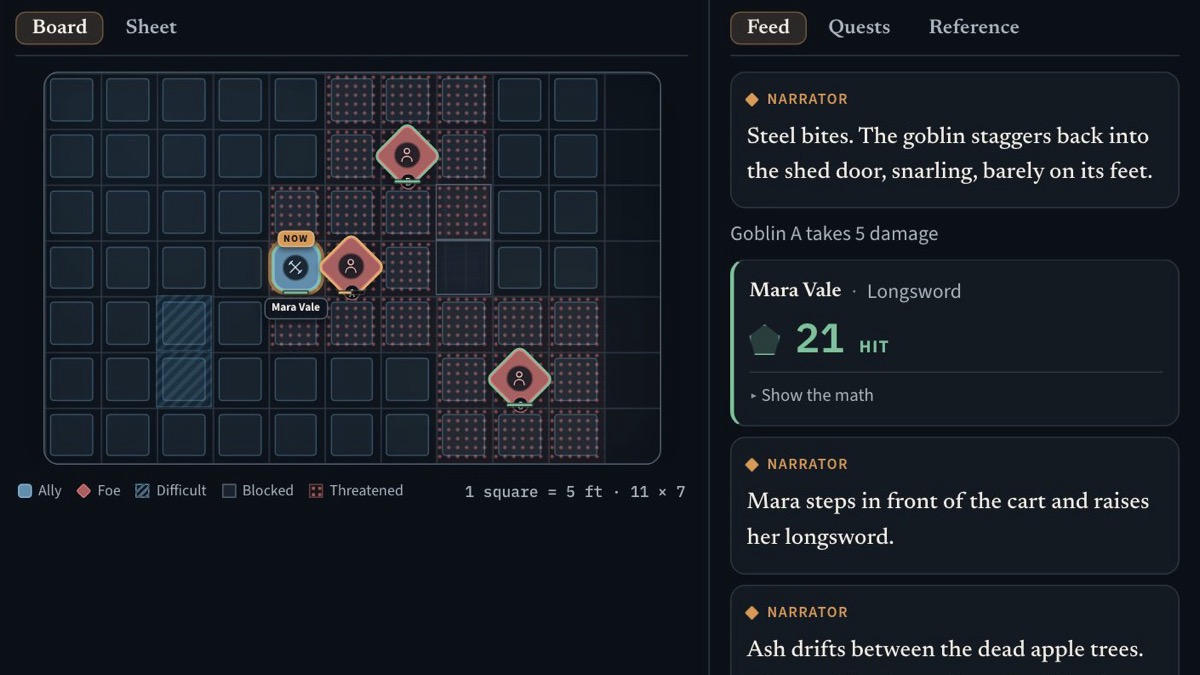
People hear "AI game master" and picture a chatbot running the whole game: setting the scene, rolling dice, deciding who hits, and keeping track of hit points in its head. That setup has a known weakness. A language model is good with words and unreliable with arithmetic and bookkeeping. Ask it to track six creatures over ten rounds and something will slip.
A table that works splits the job in two. The narrator describes the scene and suggests what happens next. A deterministic rules engine rolls every die and applies every rule. Here is how that split works at the table, with real numbers.
What an AI game master is good at
A good narrator does the talking a human GM would do between rolls. It describes the room, voices the people in it, recaps last session, and reacts when a player tries something odd.
Say your party pushes open the door of a small shrine. A human GM might say:
"Candle smoke hangs under the low ceiling. A robed figure kneels at the altar, then rises slowly and turns to face you, one hand on a plain wooden club."
That figure is an acolyte from the 5.1 SRD. A narrator can write that description well. It can also keep the scene moving. It reminds a quiet player it is their turn, answers "what does the altar look like?" and pulls in the hooks the adventure module prepared.
That is the narrator's job: words, pacing, tone. It is useful work, and it is the part a model does well.
What an AI game master should never decide
The narrator stays out of anything with a number in it. In concrete terms, it should never:
- Roll a die, or claim a die came up a certain way.
- Decide whether an attack hits or a saving throw succeeds.
- Decide how much damage something deals.
- Add or remove hit points, spell slots, or conditions.
Here is why this matters. Suppose the acolyte casts sacred flame at your fighter, Mira. The acolyte's stat block lists a spell save DC of 12. If the narrator rolled for Mira, you would have no way to check the roll. If it "remembered" Mira had 7 hit points when she really had 12, nobody might notice until it decided a fight. One wrong number, repeated over a session, turns into a different game than the one you think you are playing.
So the narrator gets no access to the math at all. It does not get the math with a promise to be careful.
Why the dice belong to a deterministic rules engine
A deterministic rules engine is ordinary code. It holds the game state: every creature's hit points, armor class, spell slots, position and conditions. It rolls the dice and applies the 5.1 SRD rules the same way every time.
Here is a turn from the shrine scene. Mira tries to force a stuck side door. The adventure module sets the DC at 13. She has a +2 Strength modifier and is proficient in Athletics, which gives her +2 at level 1.
d20 (14) + 2 + 2 = 18 vs DC 13. Success.
The engine made that roll and that comparison. Only after that does the narrator describe it:
"The swollen wood groans, then gives. The door scrapes open onto a narrow stair."
Then the acolyte acts. It swings its club at Mira, whose armor class is 16. The stat block gives the club +2 to hit.
d20 (9) + 2 = 11 vs AC 16. Miss.
On its next turn it casts sacred flame. Mira has a +1 Dexterity modifier.
Dexterity save: d20 (7) + 1 = 8 vs DC 12. Fail. Damage: 1d8 (5) radiant. Mira goes from 12 to 7 hit points.
Every one of those numbers came from the engine and appears in a feed the whole party can see. The narrator only adds the description: the flash of light, Mira's grunt, the acolyte stepping back. If you want the spell's full text, it is on the spells reference rather than repeated here.
How validated actions keep the Narrator honest
In Partybound, the narrator is called the Narrator. It cannot edit the game state directly. When it wants something to happen, it proposes a game action, and the engine checks that action against the rules before anything changes.
For the acolyte's turn, the proposal is roughly "acolyte casts sacred flame on Mira." The engine checks:
- Is it the acolyte's turn, and does it still have an action?
- Does the acolyte actually know sacred flame?
- Is Mira within range, and can the acolyte see her?
If every check passes, the engine resolves the spell: it rolls Mira's save, rolls damage, and updates her hit points. If a check fails, the action is rejected and nothing changes. The Narrator cannot write "Mira takes 8 damage" and make it true. Saying it changes nothing on the sheet.
The same goes for the acolyte's spell slots. It has three 1st-level slots. If the Narrator proposes a fourth cure wounds, the engine refuses because the slot is not there. The story bends around the rules, not the other way around.
This is what lets a group trust an AI game master setup without trusting a language model with the math. You do not need the Narrator to be careful with numbers. It never touches them.
When the rules are silent, and what the engine does
The 5.1 SRD does not cover everything. Sometimes it leaves a call to the GM. Initiative ties are a good example. The SRD lets the GM settle the order of tied creatures they control, lets players settle ties among their own characters, and lets the GM decide a tie between a monster and a player character.
Code cannot leave a call open. The engine has to do something, so it uses one fixed rule and applies it the same way every time. That rule is the engine's choice, not an official ruling, and it should be described that way. When we explain how Partybound handles a gap like this, we say "the SRD is silent here, and this is what the engine does." We do not present it as the one correct reading of the rules.
That honesty matters for the same reason determinism does. If you know exactly how the engine settles a gray area, you can plan around it. If the Narrator improvised a new answer each time, you could not.
The same applies to content. The engine only knows what is in the 5.1 SRD. Every monster it can run, from an acolyte to an air elemental, has a page in the monster reference, and the full rules reference covers spells and conditions too.
Party Mode or DM Mode: who runs your table
Partybound has two ways to play, and they fit different groups.
Party Mode is for a group where nobody is free to prep and run the game. The Narrator runs a prepared adventure module. It describes scenes, voices characters and proposes actions. The engine resolves every roll and rule. Everyone sees the same board, feed and character sheets in real time. It is a way to play on the weeks you otherwise would not.
DM Mode is for a person who wants to run the table themselves. They work from a console, and the engine handles the dice, the modifiers and the hit points. The GM gets to focus on the story and the players instead of adding numbers over a video call.
Neither mode is a replacement for a human game master, and neither claims to be better than one. A person at the table reads the room, improvises from nothing, and knows their friends in ways a prepared module cannot. Party Mode exists because many groups do not have that person free every week. DM Mode exists because the people who do run games should not have to do arithmetic all night.
Either way, the split stays the same. Words come from the narrator or the GM. Numbers come from the engine. More on how the table works is on the Partybound blog.
Rules text is from the System Reference Document 5.1, used under the Creative Commons Attribution 4.0 license. Partybound is not affiliated with or endorsed by the publisher. Attribution.