Play a tabletop RPG online without a game master
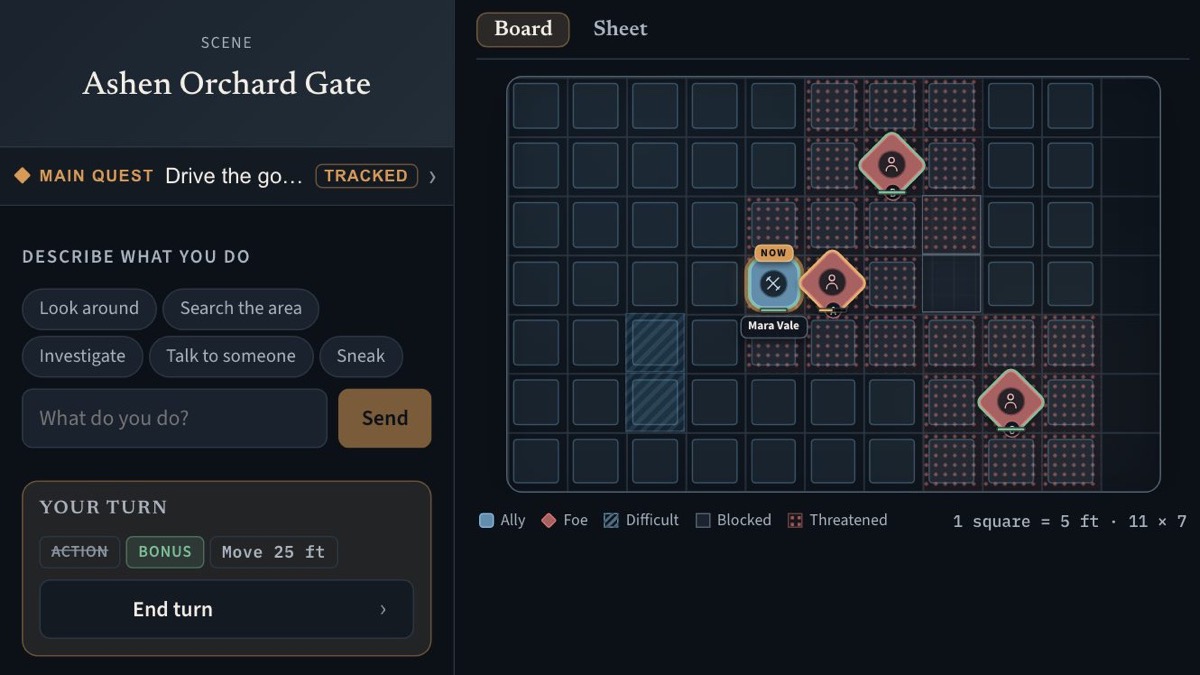
Most groups don't stall because nobody wants to play. They stall because everyone wants to play and nobody has the time to prep and run the game. If your group chat keeps saying "we should start a campaign" and nothing happens, this guide covers three practical ways to play a tabletop RPG online without a game master, and it's honest about what each one can and can't do.
Why most groups never get a game master
Running a session is a second job. The game master reads the adventure ahead of time, tracks every monster's hit points, remembers which conditions are active, looks up rules in the middle of a fight, and still has to voice every character the party meets. A single session can take two or three hours of prep.
Over a video call it gets harder. Someone rolls on a physical die nobody else can see. Someone else forgets their bonus. The GM keeps hit points in a notebook, and after an hour of back and forth everyone has lost track of whose turn it is.
So one person usually ends up doing all of that work while everyone else gets to play. When that person gets busy, the campaign stops.
Three ways to play a tabletop RPG online with no one prepping
Here are three options, from most effort to least.
1. Rotate the role. Each person runs one short adventure or one session, then hands it off. This spreads the load and works well for groups that enjoy running games. The cost is still real: whoever's turn it is still has to prep, and the rules knowledge has to live in someone's head every week.
2. Use a prepared module with the rules handled for you. A prepared adventure takes care of the story prep: locations, encounters, and the difficulty of each challenge are already written down. If a rules engine also handles rolls, hit points, and turn order, the person running the table only has to read the scene and make calls. That brings the prep down to "read the next chapter."
3. Let a Narrator run it. When nobody in the group is free at all, a narrator can run the prepared module for you. It describes scenes, voices characters, and asks players what they do. It doesn't decide the rules or the dice. The engine does.
Partybound supports options two and three. It's a web tabletop game built on the open 5.1 SRD ruleset. It covers levels 1 to 10, uses SRD content only, and hasn't launched yet.
What a rules engine handles so nobody has to
A deterministic rules engine is a program that applies the same rules the same way every time. In Partybound it does all of the mechanical work at the table:
- Rolls every die, in the open, so the whole party sees the same result in the shared feed.
- Adds the right modifiers to attacks, ability checks, and saving throws.
- Compares results to Armor Class or a Difficulty Class (DC).
- Applies damage and healing to hit points.
- Tracks turn order and active conditions like prone or frightened.
- Handles a short list of class features: Rage, Second Wind, Action Surge, Ki (Patient Defense and Step of the Wind), and Cunning Action (Dash and Disengage).
Features outside that list, like Sneak Attack or Bardic Inspiration, aren't applied by the engine. If you want to look something up, monsters and spells from the SRD each have their own reference page.
Because the engine owns the math, nobody at the table has to be the rules expert. Every player sees the same board, feed, and character sheets in real time.
How a Narrator runs a prepared module without touching the rules
In Party Mode, the Narrator runs a prepared adventure module. Its job is to describe what's happening, play the characters the party meets, and ask the players what they do.
What it can't do matters just as much. The Narrator can only act through validated game actions. It can propose something like "this creature attacks the wizard" or "call for a Strength (Athletics) check," and the engine checks that the action is legal before anything happens. The engine rolls the dice. The Narrator never edits the game state directly, never changes hit points, and can't adjust a roll after it lands.
If you want more detail on that split, our piece on what an AI game master does and doesn't do covers it in depth.
A sample round: who decides what
Here's one short round from a module. The party is a level 2 fighter and a level 2 wizard. Two acolytes guard a ruined shrine, and a collapsed wall blocks the way.
The fighter climbs the rubble. The module sets the climb at DC 13. The fighter has a +2 Strength modifier and proficiency in Athletics (+2).
Engine: Strength (Athletics) check, d20 (14) + 2 + 2 = 18 vs DC 13. Success.
Narrator: "Stones shift under your boots, but you haul yourself over the top. The nearest acolyte looks up from the altar, startled."
The acolyte casts sacred flame on the wizard. The Narrator proposes the action. The engine confirms the acolyte can cast it and that the wizard is in range, then rolls the wizard's saving throw against the acolyte's spell save DC of 12.
Engine: Dexterity saving throw, d20 (7) + 2 = 9 vs DC 12. Failure. Radiant damage 1d8 (6). Wizard hit points 14 to 8.
Narrator: "Pale fire drops from the ceiling and washes over you. It doesn't burn the stone, only you."
The fighter attacks the acolyte with a longsword. The acolyte has AC 10.
Engine: attack roll, d20 (11) + 2 + 2 = 15 vs AC 10. Hit. Slashing damage 1d8 (5) + 2 = 7. Acolyte hit points 9 to 2.
Narrator: "Your blade catches the acolyte across the shoulder. They stagger back against the altar, still on their feet, but barely."
Here's how the work was split:
| Decision | Who decides |
|---|---|
| The DC for the wall | The prepared module |
| What the fighter tries | The player |
| What the acolyte does | The Narrator proposes, the engine validates |
| Every die roll and total | The engine |
| Hit or miss, damage, hit points | The engine |
| How it sounds and feels | The Narrator |
The Narrator added the atmosphere. Every number came from the engine, and the whole party saw each one in the feed as it happened.
When to pick Party Mode and when to pick DM Mode
Neither mode replaces a human game master. They fit different weeks and different groups.
Pick DM Mode when someone in your group wants to run the table. They run the session from a console: picking scenes, playing the characters the party meets, and making the calls a person makes best. The engine handles rolls, modifiers, and hit points, so the GM can spend their energy on the story instead of the math. This also works well for groups that rotate the role, because the person running doesn't need to know every rule by heart.
Pick Party Mode when nobody is free to run it. The Narrator runs a prepared module, the engine handles every rule, and everyone gets to play. It's a good fit for a group that wants to start tonight instead of waiting for someone's schedule to clear.
Some groups will use both: Party Mode on busy weeks, DM Mode when someone has the time and the itch to run something. Either way, the rules stay the same, the dice stay honest, and the campaign keeps going.
If you want to get familiar with the ruleset before your first session, the SRD reference library is a good place to start.
Rules text is from the System Reference Document 5.1, used under the Creative Commons Attribution 4.0 license. Partybound is not affiliated with or endorsed by the publisher. Attribution.