One-shot adventure prep checklist for one evening
You have one evening to prep and a two-hour slot with friends later this week. This is a practical one-shot adventure prep checklist for the open 5.1 ruleset. It covers what to decide, what to skip, and how to spend your prep time so that game night runs on time and actually ends.
A rough prep budget for the evening:
- 20 minutes: premise and goal
- 30 minutes: pre-made characters
- 45 minutes: three scenes and a fallback
- 30 minutes: encounters
- 15 minutes: time budget and a final read-through
That comes to about two hours and twenty minutes. If you go over in one step, take the time back from the next one.
What a two hour one-shot tabletop session can hold
Two hours goes by faster than most new game masters expect. Over a video call, with four players, a realistic session holds:
- One clear goal
- Three scenes
- One or two fights, each lasting three or four rounds
- A handful of ability checks and saving throws
- A short ending where the players see what their choices changed
Combat costs the most time. A round with four players and three or four monsters usually takes five to eight minutes once people talk through their turns. A four-round fight can easily take 30 minutes. Plan two fights at most, and make one of them optional.
Leave out the shopping trip, the long travel montage, and the open city to explore. They are fun in a campaign, but in a one-shot they eat the clock.
Pick a premise and a single goal the table can finish
Write your premise in one sentence that names a place, a problem, and a deadline. For example:
A village shrine has gone quiet, the priest is missing, and the harvest festival starts at dawn.
Then write the goal as something the players can finish: "Find the priest and stop whatever is happening in the shrine before dawn." A finishable goal keeps the table focused. When players drift, you can point back to it without breaking the mood.
Pre-made characters. Hand out characters instead of building them at the table. Character creation alone can take an hour. Make four characters at 3rd level from the SRD classes, such as a fighter, a cleric, a rogue, and a wizard. At 3rd level they have enough options to feel capable and are simple enough to learn in five minutes. Give each one a single line of motivation tied to the premise, such as "The missing priest raised you." That one line does more for roleplay than a full backstory.
Build three scenes and a fallback
Three scenes give the session a beginning, middle, and end. Each scene needs a purpose, a way in, and a way out.
- The hook (village square). Townsfolk explain what is wrong. One clue points to the shrine. This scene is mostly talking, plus maybe one check.
- The approach (shrine grounds). A challenge stands between the players and the shrine: a locked gate, guards, or a trap. This is where your first encounter or a key check goes.
- The confrontation (inner sanctum). The source of the problem and the final fight or bargain.
For each scene, write down the one check that matters most and its DC. Here is what a key check looks like when it is resolved. The rogue searches the shrine gate for a hidden latch with a Wisdom (Perception) check against DC 13: d20 (14) + 2 (Wisdom) + 2 (proficiency) = 18 vs DC 13. Success. The players find the latch and move on.
The fallback. Write one line for what happens if the players fail or stall. For example: "If they don't find the latch in five minutes, a nervous acolyte opens the gate from inside and tries to bargain." A fallback means a failed roll changes the story instead of stopping it. In a two-hour game, this matters more than any other prep step.
Choose encounters from the SRD and set the difficulty
Pick monsters that fit the premise and that you can run without studying them. For a shrine story, the acolyte is a good fit. It is a low-challenge spellcaster with a few healing and support spells. Pair two acolytes with four cultists and you have a fight that feels busy but stays short.
Don't copy stat blocks into your notes. Every SRD creature has a page in the monster reference, and every spell is listed in the spell reference. Just note the page, the creature's tactics in one line, and when it gives up or runs.
For the shrine fight, the notes might read:
- 2 acolytes: stay back, cast bless on the cultists, then attack with sacred flame.
- 4 cultists: rush the front line. If two go down, the rest surrender.
On setting difficulty: the SRD gives each monster a challenge rating and an XP value. It does not give you a full method for building balanced encounters, so judge it yourself. For a one-shot, aim a little easy for the first fight and a little hard for the last one. Leave yourself a dial for each fight, such as "add two cultists if this is going too fast" or "one cultist flees on round two if it's dragging."
Budget the two hours minute by minute
Here is a 120-minute plan you can paste into your notes:
| Time | Block | Minutes |
|---|---|---|
| 0:00 | Welcome, hand out characters, safety check | 10 |
| 0:10 | Scene 1: the hook | 25 |
| 0:35 | Scene 2: the approach | 35 |
| 1:10 | Scene 3: the confrontation | 35 |
| 1:45 | Wrap-up and epilogue | 10 |
| 1:55 | Buffer | 5 |
Write the clock times next to each scene. When you hit 1:10 and the players are still at the gate, use your fallback and move them inside. When you reach 1:45, end the fight. Have the last cultists surrender or flee, and narrate the ending. A session that ends on time with a clear finish feels better than one that runs 40 minutes over.
Use the 10-minute opening for a short safety check. Ask what topics people would like to avoid, and agree on how anyone can pause the scene.
Hand off the math so you can run the story
Most of the stress in running a game comes from tracking numbers, not from telling the story. During a fight, the GM is often juggling initiative order, monster hit points, who is concentrating on bless, and which conditions are active, like prone or frightened. Every one of those can slow a round down or end in a mistake.
Here is a sample round from the shrine fight to show how much there is to track:
- The fighter attacks a cultist: d20 (12) + 3 (Strength) + 2 (proficiency) = 17 vs AC 12. Hit. The cultist takes 1d8 (6) + 3 = 9 slashing damage and drops.
- An acolyte casts sacred flame on the wizard. The wizard makes a Dexterity save: d20 (9) + 1 = 10 vs DC 12. Fail. The wizard takes 1d8 (5) radiant damage.
- The fighter, bloodied by the cultists, uses Second Wind as a bonus action: 1d10 (7) + 3 = 10 hit points regained.
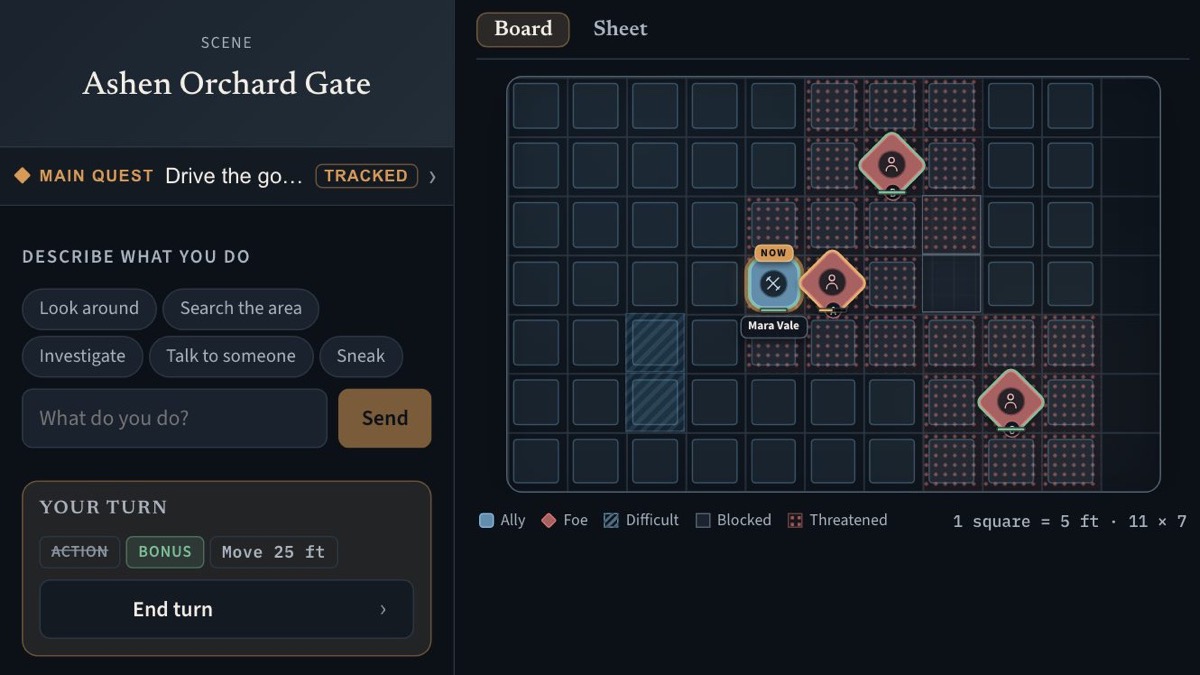
You can track this on paper, but it adds up. A rules engine can handle it for you. In Partybound, one deterministic rules engine rolls every die, applies the rules, and updates hit points and conditions. Everyone sees the same board and the same feed. In DM Mode, you run the table from a console. You decide what happens next and the engine does the arithmetic. It automates only a short list of class features (Rage, Second Wind, Action Surge, some Ki options, and Cunning Action's Dash and Disengage), so anything outside that list stays your call.
If nobody in your group has an evening free to prep, Party Mode lets the Narrator run a prepared adventure module. The Narrator describes the scene and proposes actions. The rules engine checks every action and resolves every roll, so the Narrator never changes hit points or decides a hit. You can read more about what the AI game master does and doesn't do, or how to play a tabletop RPG online without a game master.
To be clear about where things stand: Partybound isn't launched yet. It will be web-only, cover levels 1 to 10, and use SRD content only. The SRD is used under CC BY 4.0, as described on the attribution page.
Whatever tools you use, the checklist stays the same: one sentence of premise, one finishable goal, four pre-made characters, three scenes with a fallback, two fights at most, and a clock in your notes. That fits into one evening of prep, and it gets your table to a real ending.
Rules text is from the System Reference Document 5.1, used under the Creative Commons Attribution 4.0 license. Partybound is not affiliated with or endorsed by the publisher. Attribution.